How Many Families With 4 Children in America
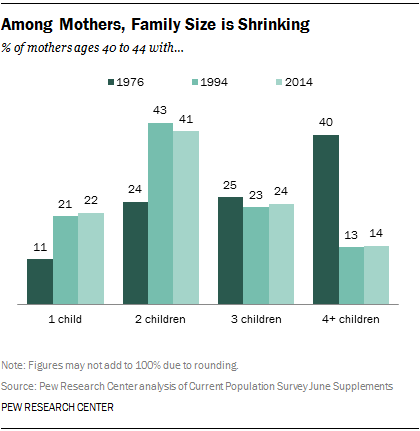 In the tardily 1970s, the average mother at the end of her childbearing years had given birth to more than three children. Since that time, average family size has declined, driven largely by declines in families with four or more than children. Now, moms have ii.4 children on average – a number that has been fairly stable for two decades.
In 1976, four-in-x mothers ages 40 to 44 had 4 or more children. One-fourth had three children, and a similar share (24%) had 2 children. Merely 11% of mothers at the cease of their childbearing years had had only ane kid.
Flash forrad to 2014, and the situation has inverse dramatically. The one time-dominant four-child family unit has been replaced by the two-child family unit. A plurality (41%) of moms at the end of their childbearing years now study having ii kids, while just xiv% accept iv or more children. Meanwhile, the share of mothers at the end of their childbearing years who have one child has doubled – from 11% to 22%. As has been the instance for many decades, about one-4th of mothers take three children (24%).
Most of the change in family size occurred between 1976 and the mid-1990s. Family size since that time has remained quite stable.
Number of Children, by Educational Attainment
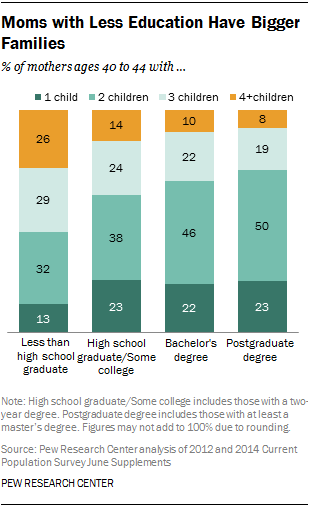 The more education a mother has, the fewer children she will have on average in her lifetime. While fertility drops somewhat with each boosted level of instruction, the biggest fertility gap occurs betwixt women who lack a high schoolhouse diploma and those who take completed loftier school.
Moms ages 40 to 44 who lack a high school diploma have about 2.9 children in their lifetimes, on average, while those with a high schoolhouse diploma or some college have about ii.four kids. Mothers at the cease of their childbearing years who accept a bachelor'south degree or college accept about ii.2 children on average.
The 2-child family is the most common family type among moms with a high schoolhouse diploma or more, and it is particularly prevalent among women with a available'southward degree or higher. Some 46% of women ages 40 to 44 with a bachelor'due south caste have ii children, every bit practice half of those with at least a chief'south degree. One third (32%) of women who lack a high school diploma have 2 children, as practice 38% of those with a high school diploma or some higher experience.
More than one-half (55%) of mothers who lack a loftier school diploma take three children or more – 29% have exactly 3 children, and 26% take iv or more. The likelihood of having such large families declines markedly at higher levels of educational activity. Among mothers with a loftier schoolhouse diploma or some college experience, 24% accept 3 children and some other 14% take four or more children, while virtually one-third (32%) of mothers with a available's degree have three or more children. Meanwhile, mothers with advanced degrees are half as likely equally those lacking a high school diploma to have three or more than children – just 27% do. Some nineteen% have three children, and 8% take four or more.
While the clan of pedagogy and family size remains a strong one, in fact the educational "gap" in fertility has narrowed in the past 2 decades, driven in role by increases in family size among the highly educated.
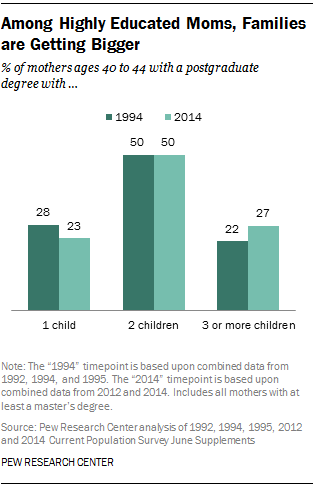 Since 1994, the share of mothers with at least a master's degree who take just one child has declined from 28% to 23%. At the same time, the share having three or more children has increased from 22% to 27%. Highly educated women are the only group in which this articulate design emerges, with a declining share having 1 child and a ascent share having 3 or more.
Among mothers who lack a high schoolhouse diploma, the share having four or more has declined by 5 points, while the share having exactly three children has increased by five points. There has been little modify in the share with fewer children.
Interestingly, among mothers with a high school diploma, the share having two children has declined by 5 pct points, down from 43% in 1994. This reject is accompanied past an increment in the share having just one kid.
Fertility patterns accept remained nearly unchanged since 1994 for mothers with a bachelor's caste.
Fertility Patterns Amid Mothers past Race and Ethnicity
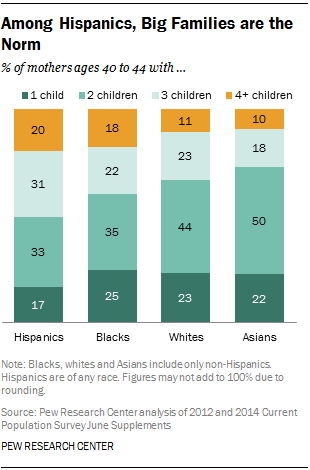 Among mothers near the end of their childbearing years, Hispanics and blacks have the largest families. On average, a Hispanic mother ages xl to 44 has had about 2.6 children. By comparison, blackness mothers take had about ii.five. White and Asian mothers have families that are a bit smaller, on average. White mothers accept ii.three children, and Asian mothers have ii.2 children.
When looking at the distribution of family size by race and ethnicity, the distinctiveness of the Hispanic family becomes particularly credible. Amid mothers ages 40 to 44, Hispanics are the least likely to have only i child – just 17% exercise. In contrast, fully 25% of blackness moms have had just one child, as is the case for 23% of white moms and 22% of Asian moms.
Conversely, Hispanics are far more than likely than others to have large families. Fully one-half of Hispanic mothers take three or more kids, compared with 40% of blacks. About one-third (33%) of whites have three or more kids, and just 27% of Asian moms do.
Among whites, blacks and Asians, having two children is the almost common event for mothers. Asian moms are the almost likely to have two children – fully half do. Some 44% of white moms ages 40 to 44 have 2 children, as do about one-3rd of black moms.
Looking at changes in fertility over time, it's apparent that families with four or more children are in decline for whites, blacks, and Hispanics. However, there are variations in which family sizes are "gaining ground" as very large families are on the wane.
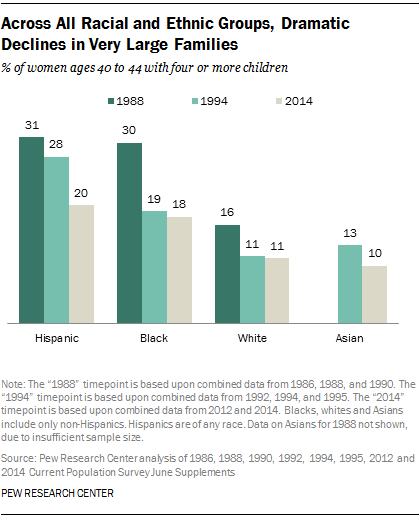 The turn down in the share of moms with four or more than kids has been particularly dramatic amid black mothers. In 1988, three-in-10 blackness mothers ages xl to 44 had four or more children, just by 2014, just xviii% did. At the aforementioned fourth dimension, the share of black mothers with one child rose by 5 percentage points (from 20% to 25%), equally did the share with two children.
The decline in the share of mothers with iv or more children has been notable amid Hispanics also. In 1988, fully 31% of Hispanic moms had four or more children. That share dropped to twenty% by 2014. At the aforementioned fourth dimension, there was an 8-pct-indicate increase in the share of Hispanic moms with exactly iii children – suggesting that many mothers were opting for three kids instead of four or more.
Among white mothers, the half-dozen-indicate decline in families with four or more children has been totally beginning by the 6-point ascension in only children.
Data on Asian mothers are unavailable for 1988, merely since 1994, at that place has been no significant modify in the size of their families.
blackwellacesturod.blogspot.com
Source: https://www.pewresearch.org/social-trends/2015/05/07/family-size-among-mothers/
0 Response to "How Many Families With 4 Children in America"
Enregistrer un commentaire